

Binggui Zhou (周炳贵) received his Ph.D. degree in Electrical and Computer Engineering from the University of Macau, Macao, China, in 2024, with the State Key Laboratory of Internet of Things for Smart City (SKL-IOTSC) and under the supervision of Prof. Shaodan Ma (IEEE Senior Member, IEEE ComSoc Distinguished Lecturer, Associate Director of the SKL-IOTSC). He is currently a Marie Curie Fellow with the Department of Computer Science, Faculty of Electrical Engineering, Mathematics and Computer Science, Delft University of Technology, Delft, The Netherlands, working with Prof. Arash Asadi (IEEE Senior Member). From Sept. 2024 to Aug. 2026, he was a Postdoctoral Research Associate with the Department of Electrical and Electronic Engineering, Faculty of Engineering, Imperial College London, London, United Kingdom, working with Prof. Bruno Clerckx (IEEE Fellow, IEEE ComSoc Distinguished Lecturer).
Dr. Zhou’s research interests lie in artificial intelligence (AI) and AI-native wireless systems, with a focus on massive MIMO, reconfigurable intelligent surface (RIS), and integrated sensing and communications (ISAC). He has published more than 30 papers in top-tier journals and flagship international conferences (e.g., IEEE TWC, IEEE TCOM, IEEE RBME, KBS, IEEE IoT-J, IEEE TNSE, IEEE TVT, IEEE WCL). His research interests lie in artificial intelligence (AI) and AI-native wireless systems, with a focus on massive MIMO, reconfigurable intelligent surface (RIS), and integrated sensing and communications (ISAC). He serves as an Associate Editor for IEEE WCL. He has served as a General Co-Chair for workshops in IEEE GLOBECOM 2026 and IEEE/CIC ICCC 2026. He also serves as a Committee Member of the 2nd UK Working Committee of the China Institute of Communications (CIC). He was a recipient of the European Union’s Marie Skłodowska-Curie Actions (MSCA) Postdoctoral Fellowship.
🔥 News
-
2026-09-01 I have joined the Department of Computer Science, Delft University of Technology as a Marie Curie Fellow.
-
2026-07-20 New publication: One paper titled Beyond-Diagonal RIS Under Non-Idealities: Learning-Based Architecture Discovery and Optimization has been accepted by IEEE Transactions on Wireless Communications.
-
2026-06-01 New submission: One paper titled Lossy Microwave Linear Analog Computer (MiLAC) for Future MIMO: Learning-based Architecture Designs for Spectral and Energy Efficiency Maximization has been submitted to IEEE Transactions on Mobile Computing for possible publication.
-
2026-05-19 New submission: One co-authored paper titled Low-Complexity Channel Estimation Framework for Non-Square UPA-Assisted XL-MIMO Systems has been submitted to IEEE Transactions on Wireless Communications for possible publication.
-
2026-04-22 New publication: One co-authored paper titled Deep Learning Based Channel Extrapolation for Dual-Band Massive MIMO Systems has been accepted by IEEE Wireless Communications Letters.
-
2026-04-04 Service: Two workshop proposals on “Intelligent Surfaces and Analog Computing” have been accepted by IEEE GLOBECOM 2026 and IEEE/CIC ICCC 2026, respecctively. Please consider submit your related research to our workshops!
-
2026-03-27 New submission: One co-authored paper titled Joint Training Scattering Matrix Learning and Channel Estimation for Beyond-Diagonal Reconfigurable Intelligent Surfaces has been submitted to IEEE Transactions on Wireless Communications for possible publication.
-
2026-03-05 Service: I have joined the Editorial Board of IEEE Wireless Communications Letters as an Associate Editor.
-
2026-02-09 Project: Glad to share that I have been awarded the European Union’s Marie Skłodowska-Curie Actions (MSCA) Postdoctoral Fellowships during the 2025 call (success rate: 9.6%). I will move to Delft University of Technology, Netherlands, to start my project: ISACare - Integrated WiFi Sensing and Communication for Sustainable and Robust Digital Health Monitoring.
-
2026-02-06 New publication: One co-authored paper titled Sequence-Model-Based Joint CSI Feedback and Dynamic Multiuser Precoding for FDD Massive MIMO Systems has been accepted to IEEE INFOCOM 2026 WORKSHOPS - DeepWireless: Deep Learning for Wireless Communications, Sensing, and Security.
-
2026-01-08 New publication: One co-authored paper titled Intelligent Angle Map-based Beam Alignment for RIS-aided mmWave Communication Networks has been accepted by IEEE Transactions on Network Science and Engineering.
-
2026-01-05 New publication: One co-authored paper titled Out-of-Band Modality Synergy Based Multi-User Beam Prediction and Proactive BS Selection with Zero Pilot Overhead has been accepted by IEEE Transactions on Communications.
👉 View all news and past updates
🔎 Research Highlights
My research mainly focuses on Machine Learning and Data Science as well as their applications in Wireless Communications, Wireless Sensing, and Smart Healthcare.
Recent key projects include:
- Knowledge-and-Data Driven CSI Acquisition
- Out-of-Band Modality Empowered Wireless Communications
👉 Read more about my research frameworks and demo systems
Research Highlights
1. Knowledge-and-Data Driven CSI Acquisition
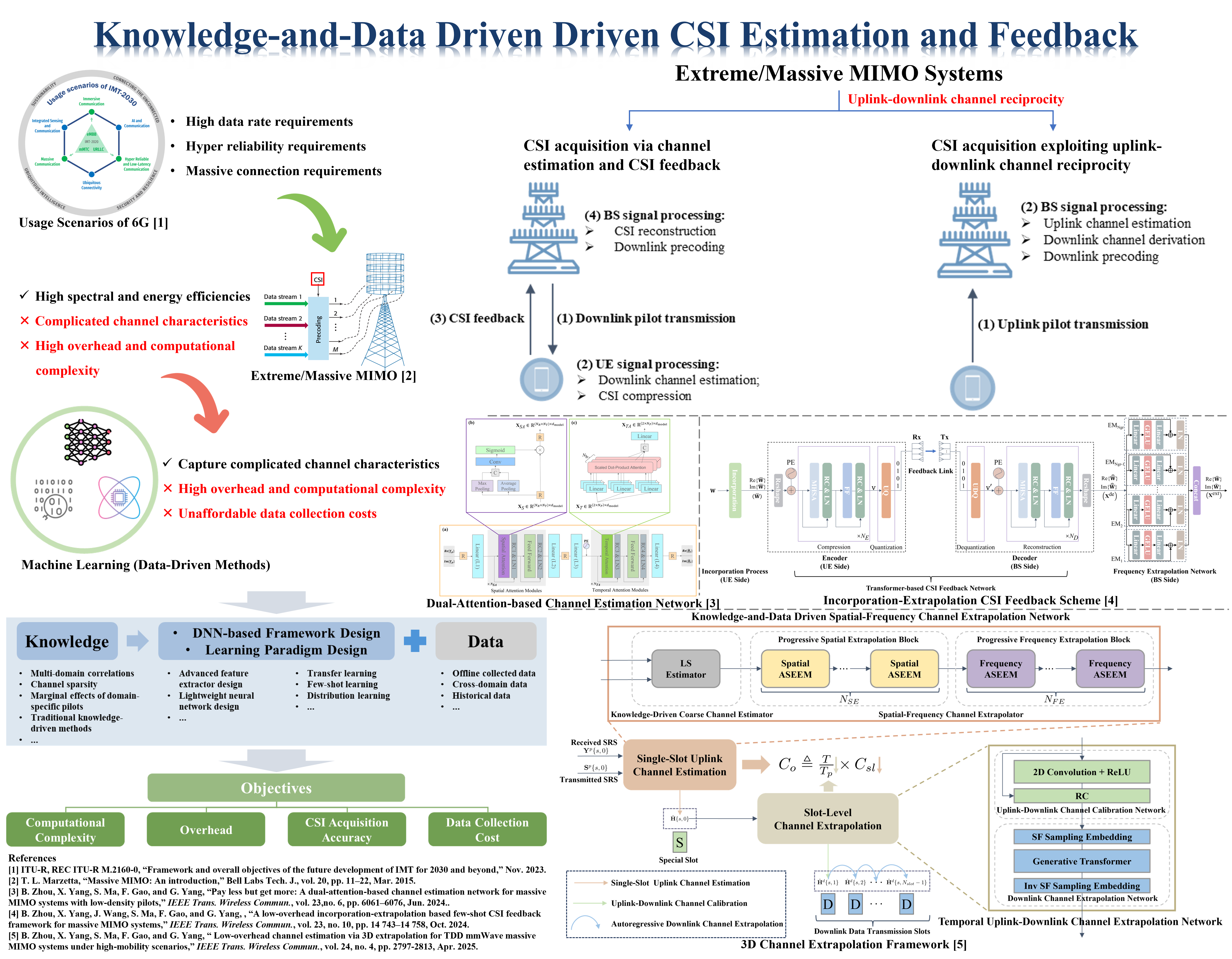
Currently, mobile communications have evolved into 5G/B5G and we are now anticipating what 6G will be like. According to [1], the usage scenarios of IMT-2030 (6G) include immersive communication, hyper reliable and low-latency communication, massive communication, ubiquitous connectivity, integrated sensing and communication, etc. These usage scenarios raise high data rate requirements, hyper reliability requirements, and massive connection requirements to current wireless communication systems. To meet these requirements, extreme/massive MIMO has been recognized as an essential technology to provide spatial degrees of freedom, diversity or multiplexing gain, and array gain, thereby improving the spectral and energy efficiencies of wireless communication systems.
However, extreme/massive MIMO also brings out complicated channel characteristics and high overhead and computational complexity, which are significantly challenging for channel state information (CSI) acquisition. It is fortunate that by learning from extensive data, some deep learning-based algorithms have been proposed to capture the complicated channel characteristics of massive MIMO channels and further improve the spectral and energy efficiencies of massive MIMO systems. Nonetheless, the high overhead and computational complexity of massive MIMO systems are not significantly reduced by existing deep learning-based algorithms. In addition, most existing deep learning-based algorithms are purely data-driven and basically rely on extensive collected data for learning the features of complicated wireless channels, leading to unaffordable data collection costs.
To simultaneously improve spectral and energy efficiencies, reduce overhead and computational complexity, and circumvent extensive data collection towards accurate and efficient CSI acquisition, we investigate how to realize knowledge-and-data driven CSI estimation and feedback, particularly for massive MIMO systems. Both domain knowledge, e.g., multi-domain correlations and channel sparsity, and learning data, e.g., historical data and cross-domain data, are exploited for framework design, learning paradigm design, and computationally efficient design to achieve the aforementioned goals. Some frameworks and algorithms we proposed are listed in the above figure, and interested readers are referred to the following publications:
[J1] Binggui Zhou, Xi Yang, Shaodan Ma, Feifei Gao, and Guanghua Yang, “Pay Less But Get More: A Dual-Attention-based Channel Estimation Network for Massive MIMO Systems with Low-Density Pilots,” IEEE Transactions on Wireless Communications, vol. 23, no. 6, pp. 6061-6076, Jun. 2024. (JCR Q1, IF: 8.9) Published Version | Preprint | Code
[J2] Binggui Zhou, Xi Yang, Jintao Wang, Shaodan Ma, Feifei Gao, and Guanghua Yang, “A Low-Overhead Incorporation-Extrapolation Based Few-Shot CSI Feedback Framework for Massive MIMO Systems,” IEEE Transactions on Wireless Communications, vol. 23, no. 10, pp. 14743-14758, Oct. 2024. (JCR Q1, IF: 8.9) Published Version | Preprint
[J3] Binggui Zhou, Xi Yang, Shaodan Ma, Feifei Gao, and Guanghua Yang, “Low-Overhead Channel Estimation via 3D Extrapolation for TDD mmWave Massive MIMO Systems Under High-Mobility Scenarios,” IEEE Transactions on Wireless Communications, vol. 24, no. 4, pp. 2797-2813, Apr. 2025. (JCR Q1, IF: 8.9) Published Version | Preprint
2. Out-of-Band Modality Empowered Wireless Communications
Vision-aided multi-user sensing and communications prototyping system:
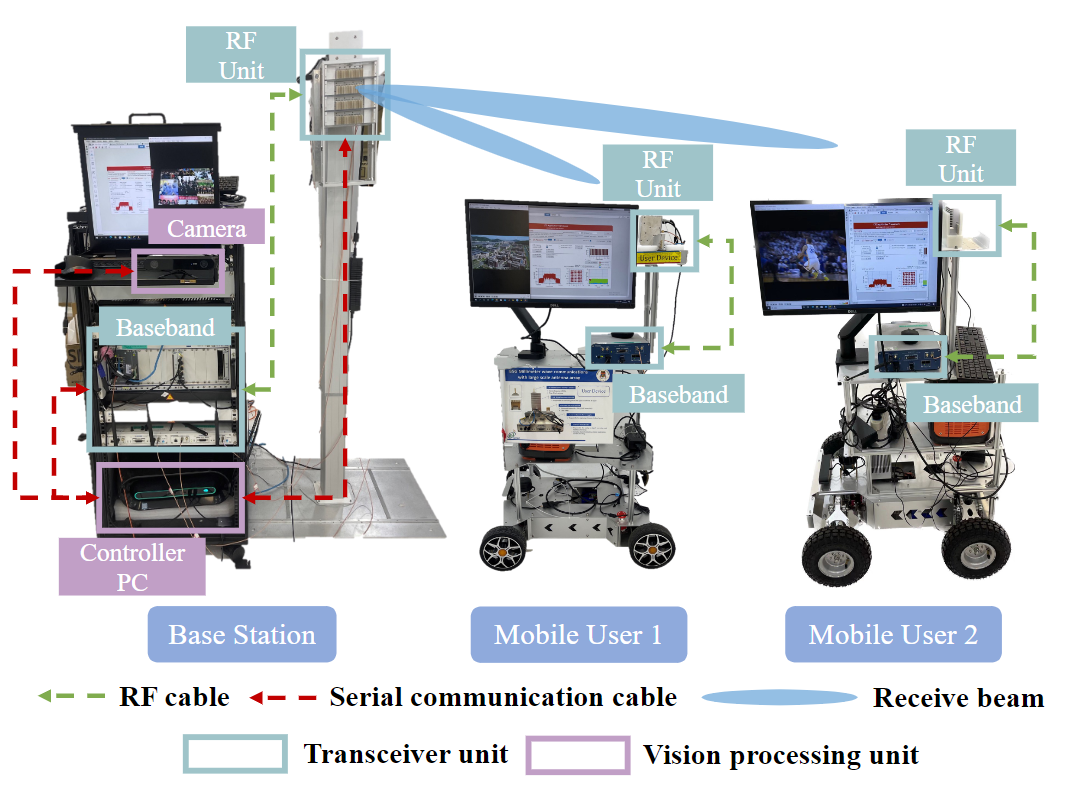
Details of the prototyping system can be found in our Lab Pages and the following publications.
[J1] Kehui Li, Binggui Zhou*, Jiajia Guo, Feifei Gao, Guanghua Yang*, and Shaodan Ma, “Out-of-Band Modality Synergy Based Multi-User Beam Prediction and Proactive BS Selection with Zero Pilot Overhead”, IEEE Transactions on Communications, vol. 74, pp. 3858-3874, 2026. (JCR Q1, IF: 8.3) Published Version | Preprint
[C1] Kehui Li, Binggui Zhou, Jiajia Guo, Xi Yang, Qing Xue, Feifei Gao, and Shaodan Ma, “Vision-aided Multi-user Beam Tracking for mmWave Massive MIMO System: Prototyping and Experimental Results,” in Proceedings of IEEE Vehicular Technology Conference: VTC2024-Spring, pp. 1-6, 2024. Published Version